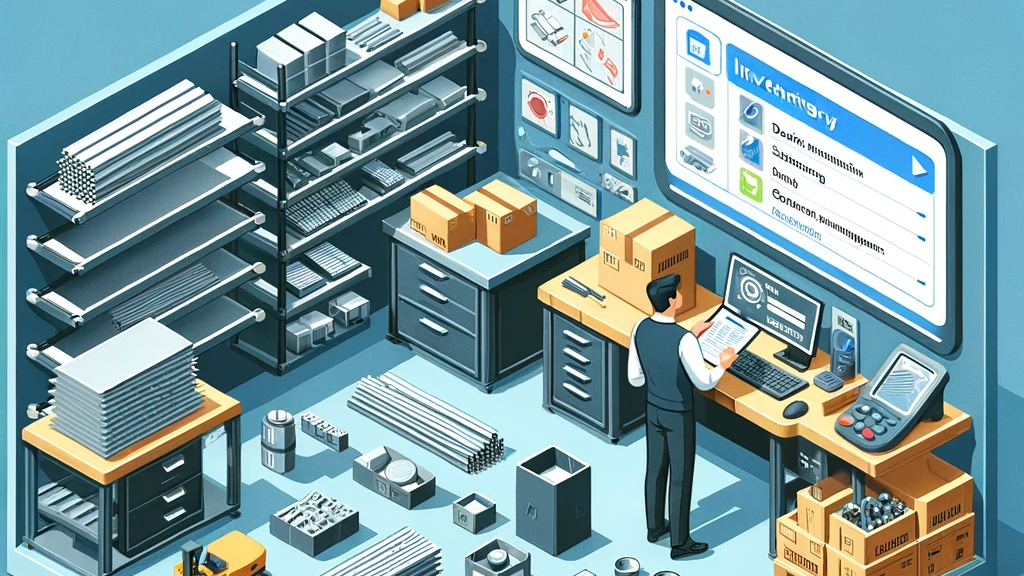
In the dynamic world of manufacturing, the mastery of raw material inventory for inventory management stands as the cornerstone of operational efficiency. In this comprehensive guide, we delve into the nuances of managing raw materials, a task that Brytebuild transforms from a challenge into a strategic asset.
Understanding Raw Materials in Manufacturing
What Are Raw Materials? Raw materials are the fundamental inputs required for manufacturing any product. These can range from unrefined natural resources like minerals, crude oil, and timber to processed materials like metal sheets, plastics, and chemicals. In a broader sense, raw materials in manufacturing also include semi-finished products or components procured from other manufacturers that are used as parts in more complex assemblies. For example, a smartphone manufacturer might use processed silicon, metal components, glass screens, and advanced microprocessors as raw materials in their production process.
Examples:
In automobile manufacturing, steel, aluminum, glass, and rubber are common raw materials.
For electronics, raw materials include silicon for microchips, copper for wiring, and various plastics for casings.
Categorising Raw Materials: Direct vs Indirect
Direct Materials: These are the core components of your product, directly contributing to its creation. For instance, wood and fabric in furniture manufacturing are direct materials, crucial for both production and inventory accuracy.
Indirect Materials: Often overlooked yet vital, indirect materials like tools and lubricants support production processes. Though they don’t form part of the final product, their role in maintaining an efficient production line is indisputable.
Raw Materials vs Work-in-Process (WIP)
WIP inventory sits between raw materials and finished goods, representing goods midway through the production process. It’s a distinct category that necessitates separate tracking from raw materials.
The Essence of Raw Material Inventory Management
Raw material inventory management is the strategic orchestration of purchasing, storing, and utilizing raw materials. It’s a balancing act between having enough stock for uninterrupted production and avoiding the financial strain of overstocking.
Why Does It Matter?
Efficient raw material inventory management is pivotal for:
Maintaining seamless production flow.
Controlling manufacturing costs.
Ensuring timely response to customer demands.
Optimising supply chain operations.
Challenges for Small Manufacturers
Small manufacturers often face a unique set of challenges due to their scale and resources:
Limited Capital: Financial constraints can limit the ability to purchase raw materials in bulk, which may prevent small businesses from benefiting from economies of scale.
Storage Space Constraints: Smaller manufacturers may have limited storage space, complicating the management of raw material inventories. This constraint requires more efficient inventory management techniques, like Just-in-Time (JIT) manufacturing, where materials are ordered and received as needed for production.
Supplier Dependence: Small manufacturers may rely on a limited number of suppliers due to smaller order volumes or specialized material needs. This reliance can lead to vulnerabilities if a supplier faces issues such as production delays or price increases.
Cash Flow Management: Balancing the costs of raw materials, production, and operations with the timing of revenue can be challenging. Small manufacturers need to carefully manage their cash flow to ensure they have sufficient funds to cover all aspects of their business.
Example: A small furniture workshop might struggle to buy wood in bulk due to upfront cost and storage issues, affecting their production capacity and cost-effectiveness.
10 Proactive Management Tips
Implement an SKU system for tracking.
Maintain an organized physical storage.
Accurately forecast demand.
Utilize safety stock and reorder points.
Align production schedules with material availability.
Conduct ABC analysis for prioritizing materials.
Foster robust supplier relationships.
Embrace Just-in-Time (JIT) inventory methods.
Ensure full traceability of materials.
Leverage MRP/ERP software like Brytebuild for comprehensive management.
Raw Material Inventory Valuation Techniques
FIFO (First-In, First-Out): This method assumes that the oldest stock (first-in) is sold or used in production first (first-out). It’s particularly useful in industries where material obsolescence or perishability is a concern.
Example: In the food production industry, FIFO ensures that older ingredients are used before they expire, minimizing waste.
LIFO (Last-In, First-Out): Contrary to FIFO, LIFO assumes the most recently acquired items are sold or used first. It can be beneficial for tax purposes in some jurisdictions, particularly during times of inflation, as it can result in lower reported profits and hence lower taxes.
Example: In a hardware manufacturing company, LIFO might be used during periods of rising steel prices to reduce taxable income.
Weighted Average Cost (WAC): This method averages the cost of all similar items in the inventory and uses this average cost to value the items sold and those remaining in inventory. It’s useful for items that are indistinguishable from each other, like screws or bolts.
Example: A manufacturer of consumer electronics may use WAC for components like resistors and capacitors, where individual cost variance is minimal.
Brytebuild, with its innovative MRP capabilities, transcends traditional management methods. It automates and simplifies inventory management, integrating seamlessly with production, procurement, and financial operations for a holistic approach.
Key Takeaways and FAQs
Raw materials are the foundational elements in manufacturing.
Efficient management is vital for operational success.
Valuation methods are key to financial accuracy.
Brytebuild offers a comprehensive solution for raw material inventory management.
FAQs:
What is raw material inventory? Example: Steel sheets in automotive manufacturing.
How do you calculate raw material inventory? Sum up costs based on valuation methods like FIFO, LIFO, or WAC.
Is raw material inventory a balance sheet item? Yes, as a current asset.
Are raw materials an inventory item? Absolutely, they’re essential for production processes.
Conclusion: Transform Your Manufacturing with Brytebuild
Embrace the future of manufacturing with Brytebuild’s MRP system. Revolutionise your raw material inventory management and turn challenges into opportunities for growth and efficiency.
Raw material control comes down to three things: knowing what you hold, what it cost, and what is already committed. Products and inventory covers the first, costing and margin the second, and MRP runs the third. The industry pages set out how this plays out sector by sector.
Here are 3 differences between MRP and MRP II
Manufacturing is a complex environment with various elements working in tandem to produce a final product. One of the core aspects that streamline the manufacturing process is efficient planning. Enter MRP and MRP II. These two systems, while related, offer different functionalities.
What is MRP?
Materials Requirements Planning (MRP) was developed to address the need for an efficient way of managing material in manufacturing. It’s an approach to inventory management and production planning that revolves around the following objectives:
The planning of components based on demand.
Delivering the right part at the right time.
Meeting the schedule for completed products.
Converting a gross requirement into a net requirement.
MRP’s primary focus is on two key areas: inventory management and production scheduling. It operates by taking various inputs:
Inventory or stock-on-hand
Order status derived from the Master Production Schedule (MPS) which represents the gross requirement
Item data like lead times and lot sizes
The Bill of Materials (BOM) which provides a detailed list of materials, components, and assemblies.
After processing this data, MRP offers outputs like:
Net Requirement and Order Release
Rescheduling and Cancellation Notices
Various reports concerning inventory, cost, item usage, and more.
What is MRP II?
Manufacturing Resource Planning (MRP II) is an evolution of MRP. It not only focuses on the production schedule and inventory management but also broadens its scope to encompass all resources in a manufacturing organisation. MRP II offers functionalities related to:
Distribution: Forecasting, sales order processing, inventory control, and purchase order processing.
Manufacturing: Master Production Scheduling (MPS), Rough-cut Capacity Planning (RCCP), work order processing, shop floor control, capacity requirements planning, Bill of Materials (BOM), and routings.
Financial: Sales ledger, purchase ledger, general ledger, and fixed assets.
Furthermore, MRP II systems are known to have two types of data:
Static: This includes the BOM, routing, item data, supplier, and customer data.
Dynamic: Comprising works orders, purchase orders, sales orders, and inventory.
It’s defined as a method for planning all resources in a manufacturing organisation, integrated with financial planning, and comes with simulation capability.
MRP and MRP II: The Distinctions
The advent of MRP in the 1970s primarily addressed production scheduling and inventory management. By the 1980s, the manufacturing sector realised the need for a system that not only managed the basics but also integrated with other crucial aspects like accounting and forecasting. This is where MRP II made its mark.
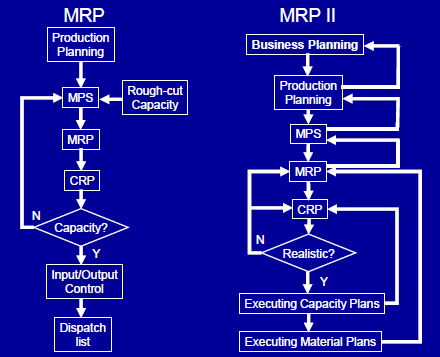
While MRP focuses on materials and production schedules, MRP II takes a more holistic approach. It brings into the picture the entire gamut of operations ranging from manufacturing, marketing, finance to engineering.
Moreover, while MRP operates as an open-loop system, MRP II aligns more with a closed-loop approach. In essence, MRP II provides a comprehensive game plan for planning and monitoring all resources of a manufacturing company.
The Evolution to ERP from MRP and MRP II:
It’s essential to understand that the world of manufacturing software didn’t stop evolving at MRP II. Enterprise Resource Planning (ERP) came into the picture as a successor to MRP II systems. ERP takes a broader perspective by focusing on the entire enterprise. While traditional MRP systems zero in on a plant’s operation, ERP systems manage the resources of an entire global enterprise.
For those venturing into the manufacturing software landscape, it’s vital to discern between MRP and MRP II. Both offer distinct functionalities tailored to specific needs. MRP II, being the successor to MRP, not only incorporates the core functionalities of MRP but also adds features to enhance forecasting, capacity management, and quality.
In Conclusion
If you’re involved in manufacturing, understanding the nuances between MRP and MRP II can be pivotal. Whether you’re looking for a system to manage materials and scheduling or require a comprehensive solution that encompasses every aspect of your manufacturing organisation, there’s a system tailored for your needs.
The distinction between MRP and MRP II matters less today than the one people actually face, which is whether they need an MRP at all or a full ERP. We set that out in ERP vs MRP. If you have already decided on MRP, the feature list shows what is included at each plan.
What is MRP (Material Resource Planning)?
Introduction to MRP (Material Resource Planning)
MRP (Material Resource Planning), is a systematic approach that aids businesses, predominantly those in the manufacturing sector, in efficiently managing their inventory, scheduling production, and ensuring the timely delivery of products. The evolution of MRP has seen various phases and classifications:
MRPI (Material Requirements Planning): Also referred to as ‘open-loop MRP,’ this system focuses mainly on converting gross requirements into net requirements based on the demand.
MRPII (Manufacturing Resource Planning): This is a more advanced version, akin to a ‘closed-loop MRP,’ and is more comprehensive, covering the broader spectrum of manufacturing processes and resources.
Why MRP?
Demand-based Component Planning: MRP ensures that every component is available based on the actual demand.
Timely Availability: It focuses on having the right part available at the right time.
Scheduled Product Completion: With MRP, you can be assured of meeting the product completion schedule.
Efficiency in Requirement Conversion: MRP is instrumental in converting a gross requirement into a more tangible net requirement.
For instance, consider a product “A” that has multiple paths (from Path 1 to Path 8) for its manufacturing. Each path may require different materials or sub-components. The Bill of Materials (BOM) breaks down these requirements. However, not every demand should be planned using MRP. For low-cost, high-volume items with commonality, non-critical nature, or easy availability, known as ‘C Class items’, other inventory strategies may be more suitable.
How MRP Works
An MRP system answers three fundamental questions:
What is needed?
How much is needed?
When is it needed by?
By addressing these, MRP offers clarity on material needs, quantities, and timelines to meet the required demand, ensuring a streamlined production schedule.
Importance of MRP (Material Resource Planning)
MRP is pivotal as it provides a clear vision of inventory requirements to meet demand. An efficient MRP system:
Prevents over-ordering, reducing carrying costs.
Avoids production disruptions due to raw material shortages.
Ensures the steady flow of the production cycle.
While manufacturing companies predominantly use MRP, its principles are applicable across various industries, from retail to hospitality, to achieve a balance between supply and demand.
MRP Processes
The core process of MRP can be segmented into four stages:
Requirement Identification: Understand customer demand and break it down into individual components using the BOM.
Inventory Check and Resource Allocation: Using MRP, assess the demand against inventory, allocate resources, and ensure materials are in the correct locations.
Production Scheduling: Utilise the master production schedule to determine timelines, resource needs, and order placements.
Issue Identification and Recommendations: MRP systems can pinpoint delays and suggest alterations to existing orders for efficient builds.
Benefits of MRP (Material Resource Planning)
Facilitates efficient planning and scheduling.
Reduces complexities by automating processes.
Prevents production delays and enhances yield.
MRP Challenges
The efficiency of an MRP system is directly proportional to the quality of input data. It’s crucial to provide accurate data on inventory, lead times, waste calculations, and other variables.
MRP vs. ERP
While MRP centres around product planning and inventory control, ERP (Enterprise Resource Planning) encompasses broader operational aspects, including financial management, customer relations, and procurement.
In Conclusion
MRP is more than just a tool; it’s a strategy to optimize manufacturing processes, ensuring that the right materials are available at the right time and in the right quantities. When implemented effectively, it can be a game-changer for businesses aiming for efficiency and profitability.
MRP is the system that answers those questions, and it is what Brytebuild does. The feature list sets out what is included at each plan, the industry pages cover the problems we hear most often in each sector, and the documentation on MRP runs shows what it looks like in use. If you are weighing it against a named alternative, start with the comparison pages.